Image Article - Imaging in Medicine (2025) Volume 17, Issue 1
Unusual Uptake of Respiratory Muscles in 18F-FDG PET-CT: Physiopathological and Correlation Meaning
- Corresponding Author:
-
Department of Nuclear Medicine, Mohammed V Military Teaching Hospital, Hospital in Rabat, Rabat, Morocco
E-mail: Ayoubdribla10@gmail.com
Received date: 04-July-2024, Manuscript No. FMIM-24-140808; Editor assigned: 07-July-2024, PreQC No. FMIM-24-140808 (PQ); Reviewed: 21- July-2024, QC No. FMIM-24-140808; Revised: 11-January-2025, Manuscript No. FMIM-24-140808 (R); Published: 18-January-2025, DOI: 10.47532/1755-5191.2024.17(1).262-264
Case Description
We share a case of 59-year-old man patient, followed for lymphocytic lymphoma for 6 months. The patient received 6 cures of chemotherapy, and was referred for PET scanner to evaluate the treatment efficiency. At this time, he reports clinically cough with dyspnea evolving in a context of hydrops.
PET–CT with 18F-FDG was performed showing physiological uptake of 18F-FDG in the 3D Maximum Intensity Projection (3D MIP) (Figure 1), and unhabitual diffuse and stepped hypermetabolism interesting intercostals muscles and diaphragm in (3D MIP) and Fused PET/CT images in axial sections (Figure 2), this exceptional uptake was explained by the breathing difficulties relating to dyspnea. In addition to this finding, multiples pleural, pericardial and abdominal effusions without hypermetabolism, were observed in the context of hydrops. We report in our exploration the total disappearance of the pathological lymph nodes hypermetabolism previously described in the intermediary PET-CT, evoking a complete metabolic response.
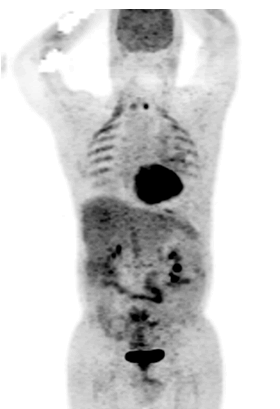
Figure 1. The 3D Maximum Intensity Projection (3D MIP) image showing high metabolic activity in the intercostal muscles.
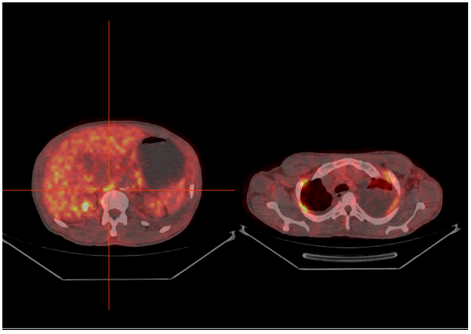
Figure 2. Fused PET/CT images in axial sections showing corresponding high intensity uptake within right diaphragm and intercostal muscles.
To our knowledge, a few studies compare visually assessed 18F-FDG uptake within the accessory muscles of respiration in chronic pulmonary diseases [1]. The increased respiratory work results in macroscopic and cellular changes, to meet the increased ventilatory demands. 18F-FDG is a radioactive glucose analog which, much like conventional glucose, enters the cells via facilitative GLUT (Glucose Transporters) [2]. The GLUT4 isoform is present in the skeletal muscles and the uptake of 18F-FDG is high with increased metabolic activity of the muscle. In the context of breathing difficulties, to many several causes including: COPD (Chronic Obstructive Pulmonary Diseases), lung cancer and obstructive ventilatory impairment, can be responsible for the increased metabolic activity [3]. Furthermore, to evaluate correlation between this metabolic activity within the intercostal muscles and pulmonary function, some studies used 18F-FDG PET–CT with visual grading of metabolic uptake of the respiratory muscles [4]. The degree of 18F-FDG uptake was visually quantified (grade from 0 to 3) in the respiratory muscles of the neck, intercostal muscles, and abdominal muscles using mediastinal blood pool uptake and liver uptake as references (Table 1).
| Grade | Visual assessment of metabolic uptake |
| 0 | No uptake |
| 1 | ≤ mediastinal blood pool uptake (SUVmax) |
| 2 | > mediastinal blood pool uptake, ≤ liver uptake (SUVmean) |
| 3 | > liver uptake/SUV: Standardized Uptake Value |
Table 1. Visual grading of metabolic uptake of the respiratory muscles using blood pool and liver uptake as reference for each grade.
Conflict of Interest
Salah Oueriagli Nabih, Ayoub Dribla, Imtissar El Moatassim, Omar Ait Sahel, Abderrahim Doudouh declare that they have no competing interests.
Ethical Approval
All procedures performed in studies involving human participants were in accordance with the ethical standards of the institutional and/or national research committee and with the 1964 Helsinki declaration and its later amendments or comparable ethical standards. For this case report, formal consent is not required.
Availability of Data and Material
Authors make available to all scientists, documents described in the manuscript, including new software, databases and all relevant raw data.
Funding
Authors declare that there is no funding for our article.
Consent Statement
Written informed consent was obtained from the patient for publication of this case report and any accompanying images. A copy of the written consent is available for review by the Editor-in- Chief of this journal.
Informed Consent
The institutional review board of our institute “Med V Military Teaching Hospital” approved this publication, and the requirement to obtain informed consent was waived.
Authors’ Contributions
Conceptualization: Dr. Dribla
Investigation: Dr. Dribla and Dr. EL Moatassim and Dr. OTMANI
Methodology: Pr. OUERAGLI and Dr. DRIBLA
Formal analysis: Pr. Ait Sahel and Dr. El MOATASSIM
Writing–original draft: Dr. Dribla and Pr. OUERIAGLI
Writing–review and editing: Pr. oueriagli and Pr. Doudouh
All authors read and approved the final manuscript.
Acknowledgements
There is no acknowledgement for this publication.
References
- Esha Kothekar, Austin J Borja, Oke Gerke, et al. Assessing respitatory muscle activity with 18F-FDG-PET/CT in patients with COPD. Am J Nucl Med Mol Imaging. 9, 309-315 (2019).
[Google Scholar] [PubMed]
- Karunanithi S, Soundararajan R, Sharma P, et al. Spectrum of physiologic and pathologic skeletal muscle (18)F-FDG uptake on PET/CT. AJR Am J Roentgenol. 205, 141-149 (2019).
[Crossref] [Google Scholar] [PubMed]
- Klimathianaki M, Vaporidi K, Georgopoulos D. Respiratory muscle dysfunction in COPD: from muscles to cell. Curr Drug Targets. 12, 478-488 (2011).
[Crossref] [Google Scholar] [PubMed]
- Aydin A, Hickeson M, Yu JQ, et al. Demonstration of excessive metabolic activity of thoracic and abdominal muscles on FDGPET in patients with chronic obstructive pulmonary disease. Clin Nucl Med. 30, 159-164 (2005).
[Crossref] [Google Scholar] [PubMed]